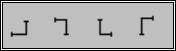
There are various destination wiring elements with different functions or tasks.
DW elements with 1 or 2 connection points could also be replaced by connection lines.
Elements with 1 or 2 connection points serve mainly to use the advantages of the automatic connections (horizontal and vertical). Corner pieces (or angles) are used to connect two lines running at right angles to each other; arrows document the continuation of the line in another position.
Corner(1) Connection line from the left turns up or vice versa
Corner(2) Connection line from the left turns down or vice versa
Corner(3) Connection line from above turns right or vice versa
Corner(4) Connection line from below turns right or vice versa
links It is essential to define the line name in order to create the line cross references.
indicate lines which end at one position and continue at another position. The line name and connection name must be entered. The conductor colour, cross-section and length can also optionally be specified
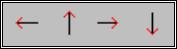
Arrow(1) Arrow direction to the left
Arrow(2) Arrow direction upwards
Arrow(3) Arrow direction to the right
Arrow(4) Arrow direction downwards
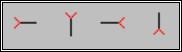
Arrow(1) Arrow direction from the left
Arrow(2) Arrow direction from above
Arrow(3) Arrow direction from the right
Arrow(4) Arrow direction from below
Elements with 3 connection points (T - pieces)
Only by using these elements is it possible to create T-connections which make it clear which points are to be connected to each other. The names of all 3-pole DW elements are derived from these.
If you look at the buttons on the first toolbar illustrated above, you will note the following:
The common connection point (with 2 wires) is depicted by a small triangle.
The secondary connection is depicted by a red line.
The following illustration explains in detail the naming of the DW elements, using as an example the element 'T-piece left, destination 1 up -> destination 2 down'.
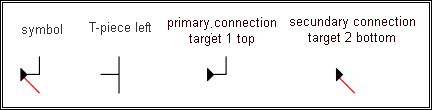
On the far left the element is shown as it appears in the toolbar (button). Picture the connection as a T-piece left consisting of 2 connections. Connection 1 begins on the left on the common point and leads upwards to destination 1. Connection 2 begins at the same point but leads downwards.
The following rule must be adhered to when using these DW elements:
Rule
The common connection point, identified by a triangle, must ONLY be connected to a component, NOT to another 3-pole DW element.
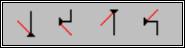
T-piece1 T left; destination 1 up, destination 2 left
T-piece2 T left; destination 1 up, destination 2 down
T-piece3 T left; destination 1 down, destination 2 left
T-piece4 T left; destination 1 down, destination 2 up
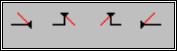
T-piece1 T up; destination 1 left, destination 2 up
T-piece2 T up; destination 1 left, destination 2 right
T-piece3 T up; destination 1 right, destination 2 left
T-piece4 T up; destination 1 right, destination 2 up
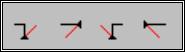
T-piece1 T down; destination 1 left, destination 2 right
T-piece2 T down; destination 1 left, destination 2 down
T-piece3 T down; destination 1 right, destination 2 left
T-piece4 T down; destination 1 right, destination 2 down
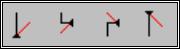
T-piece1 T right; destination 1 up, destination 2 right
T-piece2 T right; destination 1 up, destination 2 down
T-piece3 T right; destination 1 down, destination 2 up
T-piece4 T right; destination 1 down, destination 2 right