Equipment labels
 The reference names
of all symbols can be printed on labels. For this purpose, you have to
provide certain data (e.g. width, height, distance, etc.) about the labels
you need. The text to be printed will be positioned on the sheet according
to these guidelines. You can define for example, if the text shall be
aligned to
the left or centered and include unit and/or field codes. Font type and point
size can also be determined. The following settings have influence
on the positioning of the labels.
The reference names
of all symbols can be printed on labels. For this purpose, you have to
provide certain data (e.g. width, height, distance, etc.) about the labels
you need. The text to be printed will be positioned on the sheet according
to these guidelines. You can define for example, if the text shall be
aligned to
the left or centered and include unit and/or field codes. Font type and point
size can also be determined. The following settings have influence
on the positioning of the labels.
You can save the composition with an appropriate name. In order to do
this, you enter a name in the middle line and then click on the disk symbol.
You can delete the file with the red X.
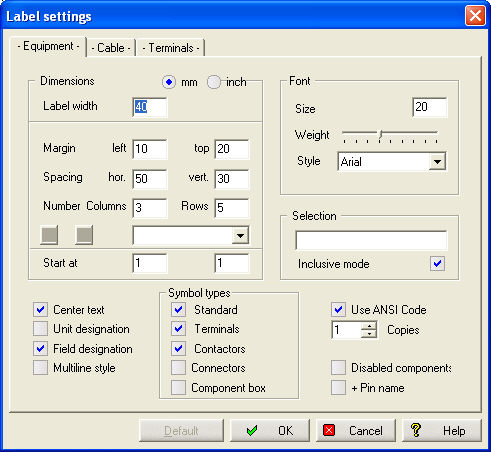
Start at means to begin printing
at Column x and Row y .
symbol types allows you to limit
the output to:
symbols of the type standard, main / additional
element
symbols of the type terminals
symbols of the type contactors (coil, protection
switch)
symbols of the type connectors
symbols of the type Component box
In addition, you can control the label output by entering a reference
name (or several, separated by a comma). It is possible to use the wildcards *, ? and #. If the switch
inclusive is activated, only those
symbols will be included, the reference
of which corresponds to the definitions (or one of them). If the switch
is deactivated, only those symbols will be processed, the reference
of which does not correspond to the definitions (or one of them). When
a definition contains a system code, the latter will be included in the
comparison. The same applies for location
codes.
Note
In the comparison, a distinction is
made between capital and lower case letters.
Here are a few examples for the use of wildcards:
|
Definition |
Effect |
|
-K* |
All symbols, the equipment code of which begins with K,
regardless of a possible unit or field code |
|
-#K* |
All symbols, the equipment code of which contains any
number of digits (0 ... 9) before the K. |
|
-#K2? |
All symbols with the following equipment code, e.g. 1K21,
10K25, 71K23 |
|
-K1?.* |
All symbols, the equipment code of which begins with K1,
followed by any sign and a point (.). Other signs can but do not have
to be present. |
|
=Unit*-K* |
All symbols, the code of which begins with Unit and the
equipment code of which begins with K. The location code is not taken
into account. |
|
=Unit*+Field?-K* |
All symbols, the system code of which begins with unit and the field code of which begins
with K. In addition, the location code must begin with Loc and can consist
only of four signs. |
|
+Field? |
All symbols, the location code of which begins with field and
has exactly four signs. |
Tip
The indications via left or top border define values related
to the border of the sheet. The printer driver already defines a minimum
value so that in the configuration you cannot go below this value. In
any case, it is recommended to correct the configuration values after
a test printout on normal paper.
Copies
With the setting Copies, you can achieve output of equipment and cable
labels in 1 to 9 copies.
In general ANSI code
With the option Output in ANSI code,
you can determine if DOS or ANSI (=Windows) code sets shall be used for
labelling systems in the output
to a file. When the setting is wrong, special letters such as ä or Ü are
incorrectly displayed.
Disabled components
With this option, the construction elements that are blocked
for the material list are edited as a label regardless.
Add project info to equipment labels
With an extension, information from the project
manager can be included in output to Excel or Access:
For this it is necessary to make an entry in the WSPRJ5xAT.INI:
..[Config Labels Equipment]
AddPrjInfo=S,80006,80002
At the beginning is a letter which determines if the information will
be in all lines (A) or only in the first line (S).
Then follow the IDs of the fields
from project management, 80006 = customer
name, 80002 = project number.
All standard fields of the project manager are possible
with the exception of 80009, because this is the location which collides
with a previously existing field name for the location code.